
AI Document Validation for Insurance Claims
An AI Document Validator that checks the consistency and truthfulness of insurance claim documents, recognizes photos and catches duplicate images.

An AI Document Validator automatically checks the validity and consistency of a claim’s documents — policy, vehicle registration, photos of the damage and of the intervention — cross-referencing the data and recognizing the images, and flags inconsistencies and photos already used in previous claims. For an operator in the automotive aftermarket sector we designed and built one, orchestrated around SharePoint.
The client operates in auto glass repair and replacement, a business strongly tied to the handling of insurance claims: every intervention on a windscreen translates into a claim with documentation to validate against the insurer. That is where time, error risk and — above all — fraud risk concentrate.
The problem: manually checking dozens of documents per claim
Every claim comes with numerous attachments: a copy of the policy, the vehicle registration, front/back ID, photos of the removed glass, end-of-intervention photos, photos of the damage before the work, the claim form, the acceptance sheet. Manually verifying the validity, the truthfulness and above all the consistency between these documents — plate, name, policy number, insurer — is slow and prone to human error.
But the most delicate point is another: vulnerability to fraud. Inconsistent documentation, or photos reused from previous claims, can go unnoticed in a manual check over high volumes. And that is exactly the kind of anomaly that a human eye, under time pressure, struggles to catch systematically.
The solution: AI services orchestrated around SharePoint
We built a set of artificial intelligence services integrated with SharePoint and with the client’s document ecosystem. Operators upload the claim documents to SharePoint, classify the type of each document and queue the analysis via dedicated API calls.
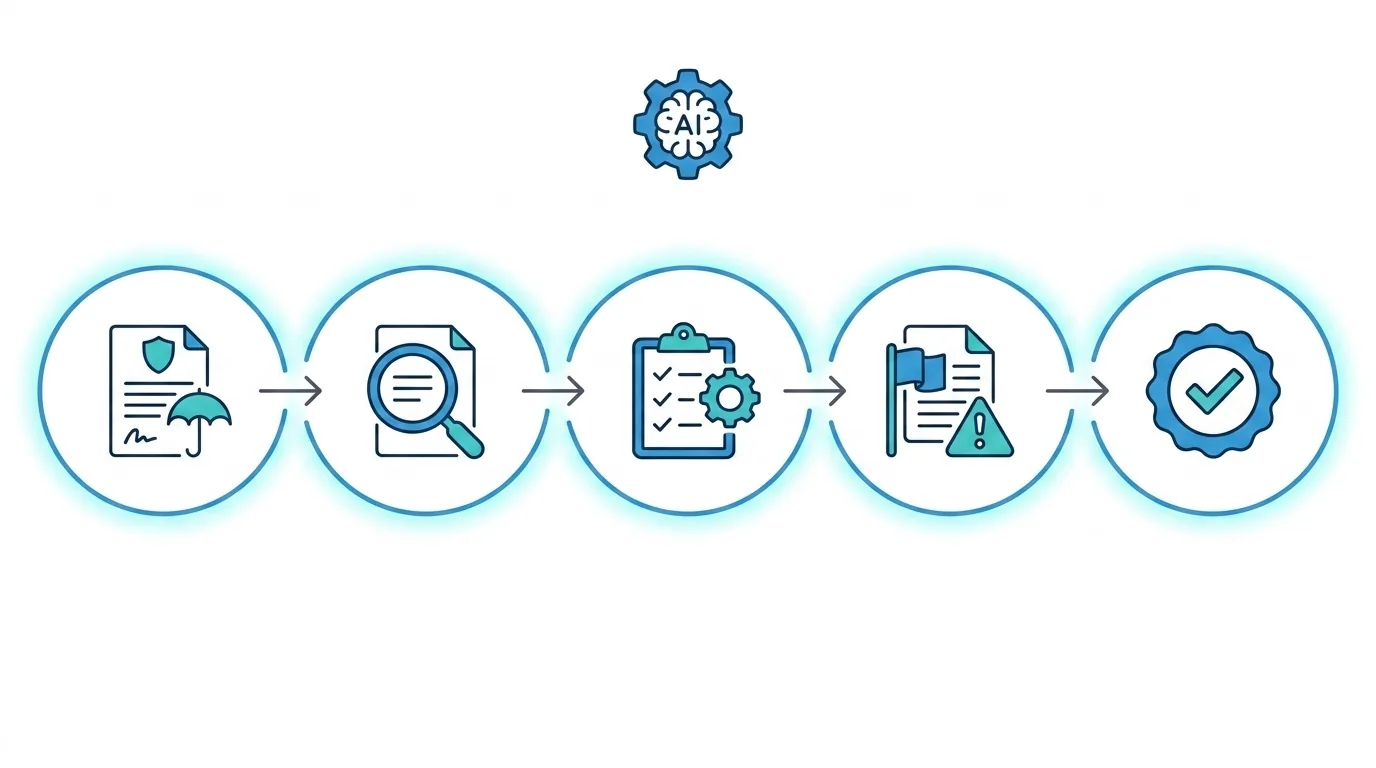
The validation flow
A web app takes on the call and queues the analysis on a SQL Server database. A scheduled job periodically checks the pending analyses and processes them by querying the AI services, which run the documentary and visual checks: extracting data from the policy, registration, claim form and acceptance sheet; checking consistency between the data and the photos; distinguishing between repair and replacement, with the checks relevant to each case. Once processing is complete, the full outcome is written to a dedicated SharePoint list — with folder, date, outcome, extracted data, step-by-step detail and a confidence score for each check.
The checks, document by document
Each type of document brings its own checks. From the policy copy the system extracts plate, name and policy number and verifies their consistency with the front/back ID photo; from the vehicle registration it recovers plate, make and model and compares them with the policy and the photos; from the claim form and the acceptance sheet it derives plate and insurer, verifying the correspondence with the data passed to the case. Upstream, the system recognizes whether it is a repair or a replacement and, based on the insurer involved, analyzes only the documents actually required for that case — avoiding superfluous checks and false alarms. It is a path of conditional checks, not a one-size-fits-all checklist: it reproduces the logic by which an experienced operator already knows where to look depending on the type of intervention and the insurer, and each step produces a confidence score, so that whoever reviews the case knows not only the outcome, but how sure the system is of each check.
Image recognition and fraud prevention
The most distinctive part is visual. The AI services recognize from the photos whether the glass is actually removed and, at the end of the intervention, correctly fitted, with a check on the visibility and consistency of the plate across the different images. In the pre-work photos, moreover, the system verifies the presence of the damage and the visibility of the plate, so as to confirm that the photographic documentation truly reflects the declared intervention. And, to counter fraud, the system computes a hash for each photo and compares it against those already used in previous claims: reused images are caught automatically. It is the same spirit with which we approach AI document processing: leaving the systematic, repetitive check to the machine, and the decision on flagged cases to the person.
The challenge: fine-tuning image recognition
The main difficulty was precisely image recognition: it required fine-tuning the agent’s instructions to guarantee adequate performance, reliably distinguishing similar visual scenarios (a removed windscreen from a fitted one, real damage from a reflection) on photos taken in highly variable conditions of light and framing. It is the point where the solution proves its real usefulness: an imprecise recognition would generate false alarms that shift the work instead of reducing it. For this reason the fine-tuning was guided by the concrete cases of real claims, iterating on the instructions until the recognition behavior became stable and repeatable.
Who benefits from this approach
This kind of solution is relevant for anyone handling repetitive document-based cases with a verification and fraud-risk component: operators tied to insurance claims, service networks that report interventions with photographic documentation, functions that must validate the consistency between declared data and documentary evidence. Wherever the check is today manual, slow and vulnerable to error or abuse, AI can make it systematic and traceable. The same approach drives the automated auditing of project financial reports, across heterogeneous documents and eligibility rules.
If your organization manually validates documents and photos of high-volume cases, an AI document validation project — on the same foundation as a custom insurance web app — can reduce both time and fraud exposure. Contact us for an assessment →

Written by
Davide Mazzoli
Modern AI Apps · Dev4Side