AI Agent for Technical Tender Analysis in Teams
How we cut tender specification analysis from days to about 15 minutes with an AI agent on Microsoft Teams, using RAG search over technical product manuals.
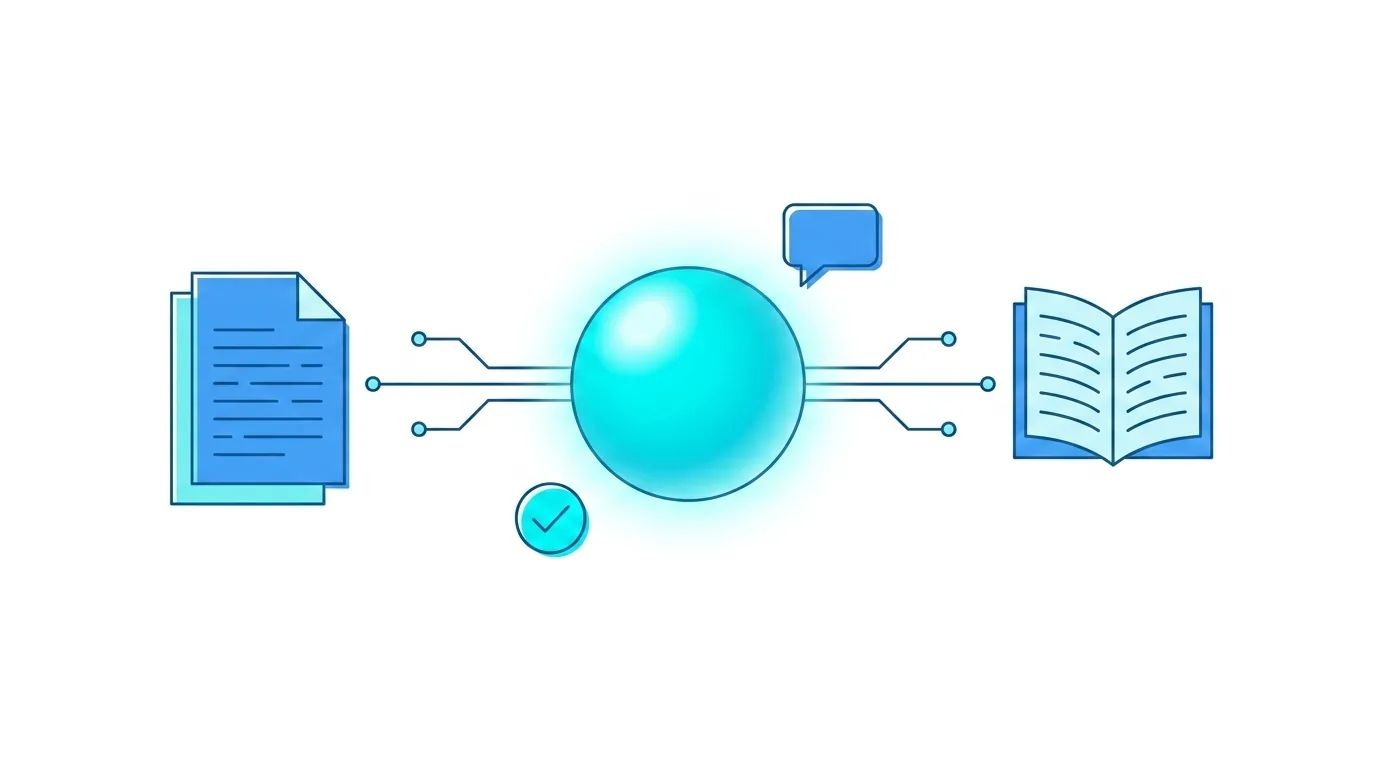
An AI agent for tender analysis is an assistant that reads a tender document, extracts each individual technical requirement and compares it against the product manual, assessing the compliance of each one and citing the exact source. For an international industrial group active in applied HVAC we built one accessible from Microsoft Teams: an analysis that manually could take several days is now completed in about 15 minutes.
The client builds machinery to specification — made-to-order solutions for comfort, process cooling and data center IT cooling. In a business model so tied to tender specifications, every incoming tender has to be read, broken down into its requirements and compared against what the machine can actually deliver. Work that absorbed days of expert technical staff. We turned it into a conversation inside Teams, on the same principle we use to build a RAG chatbot in Teams over a corporate knowledge base.
The problem: analyzing a tender is slow and depends on a few experts
For every tender, an engineer has to identify the individual modification requests contained in the specification, compare them one by one against the reference machine manual and assess their compliance — citing the correct reference to justify each conclusion.
It is a manual, repetitive and skill-intensive activity. It depends on the availability of the few people able to read both the language of the tender and the technical language of the product. And without structured support the risk is twofold: long lead times, and assessments that are poorly traceable, open to interpretation, hard to review later. Every tender thus absorbed person-days of a rare and valuable profile, taking them away from higher-value work.
The solution: an AI agent inside Microsoft Teams
We developed the “Custom Evaluator Assistant”, a generative AI agent accessible directly from Microsoft Teams — no new tool to learn. The user uploads the tender as a PDF in the chat and selects, through an Adaptive Card, the product and version of the reference manual. From there the agent works autonomously and returns a structured report.
How the analysis flow works
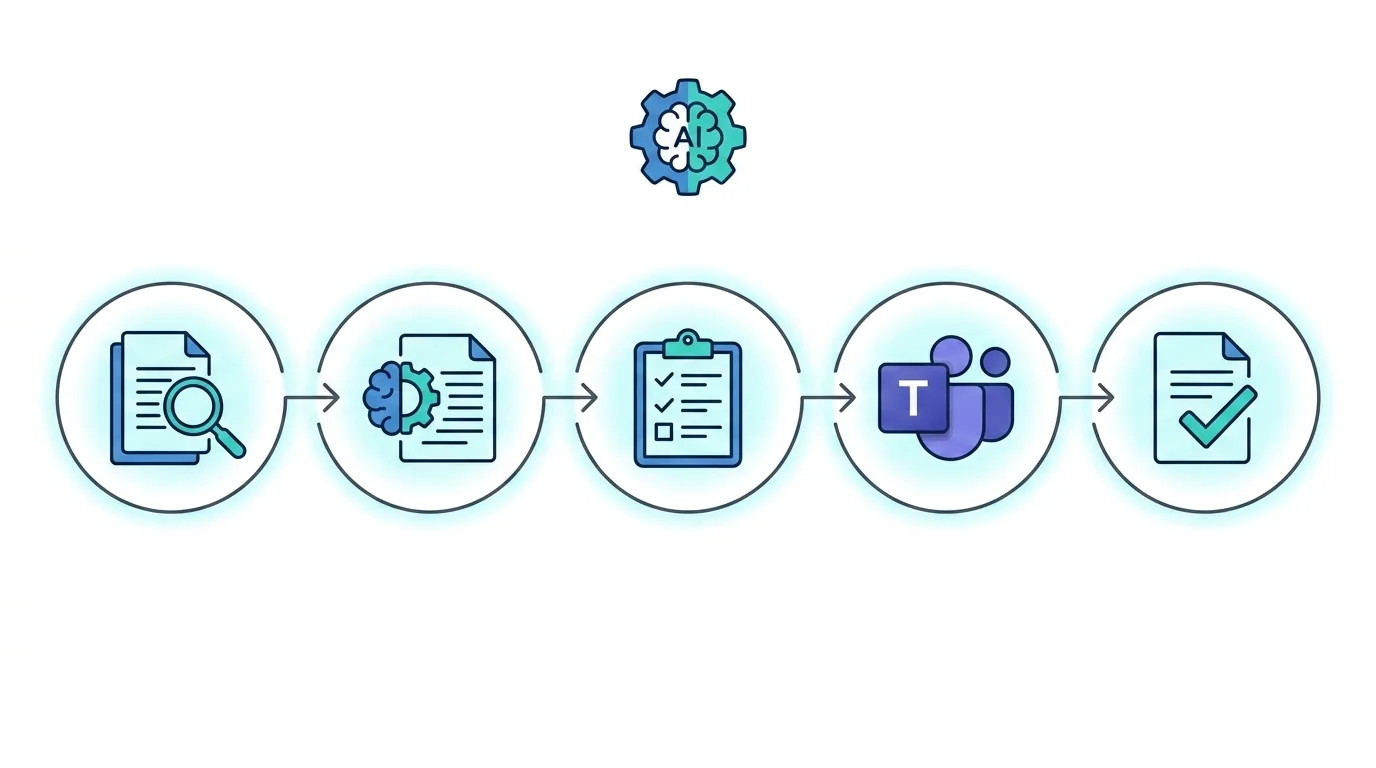
The agent parses the tender while preserving the references to the original structure, classifies the requirements by topic area and runs a semantic search (RAG) over the indexed technical manual. For each requirement it assesses compliance — compliant, partially compliant, non-compliant — and generates a report with thematic summaries, the parameters involved, suggestions and precise references to the page and section of the manual.
The technical manuals are not a static block: they are managed in a SharePoint Document Library with structured metadata, and a scheduled job handles their automatic indexing (polling, metadata validation, chunking, embedding and delta handling for new, modified or deleted documents). The final report is presented through an Adaptive Card in Teams, saved to Azure Storage and downloadable as DOCX. The user can then refine it by conversing with the agent in natural language: the agent generates new versions while keeping compliance with the company template.
The technical challenge: retrieving the right passage from the manual
The main difficulty was not generating text, but guaranteeing the truthfulness of the assessments against the technical requirements. An agent that cites the wrong manual, or an irrelevant passage, is worse than no agent: it shifts the verification work instead of reducing it.
In the early stages the technical parameters were not extracted with the necessary precision. By working on the RAG-based retrieval — how the truly relevant chunks are selected based on the tender specification — the quality of retrieval improved markedly, bringing the agent’s answers into precise alignment with the manual content. This is where a generative AI project earns its credibility: the quality of retrieval, not the eloquence of the model. It is the same principle behind the RAG conversational search of the pharma reps app we built in the pharmaceutical sector.
Security and data perimeter
The solution lives entirely within the organization’s Azure and Microsoft 365 stack. The technical manuals — a sensitive industrial asset — stay on SharePoint and Azure AI Search inside the tenant; authentication goes through Entra ID; processing happens within the company perimeter, without sending technical documentation to external services. For an industrial group this means being able to adopt generative AI without opening a new risk surface on its own product data.
Results: from several days to about 15 minutes
Given a tender in PDF, the agent extracts the technical specifications, compares them against the reference manual and produces a DOCX report with the implementation feasibility of each specification. The most concrete result is on time: an analysis that manually could take several days is completed in about 15 minutes.
But the gain is not only in speed. The assessments are now traceable by design — every conclusion cites its source — and no longer depend on the punctual availability of a single expert. The time of senior technical profiles shifts from the mechanical reading of tenders to the decision: validating, handling edge cases, shaping the commercial offer.
Who benefits from this approach
This kind of solution is relevant for companies that build or configure to specification and that, for every order, have to compare an incoming document (tender, technical request, bid specification) against a product document base — manuals, datasheets, regulations. The larger the documentation estate and the more the analysis depends on a few people, the greater the value of making it fast, traceable and repeatable.
The pattern, moreover, goes beyond tenders: wherever there is a document to compare against a technical knowledge base, the same agent can extract, compare, assess and cite the source.
If your company spends person-days of technical profiles on the analysis of repetitive technical documents, an AI agent integrated into Microsoft 365 can give that time back to the decisions that matter. Contact us for an assessment →

Written by
Davide Mazzoli
Modern AI Apps · Dev4Side