
End-to-End Microsoft 365 Security: Identity, Endpoints and Data
How we built a unified security posture for an international manufacturing group with Microsoft Entra ID, Defender, Purview and Intune, integrating tools that were already in place.

End-to-end Microsoft 365 security is the approach in which identity, endpoints and data are protected as a single coordinated system, instead of as three separate problems. For an international manufacturing group we built a unified security posture using the tools of the Microsoft ecosystem (Microsoft Entra ID, Microsoft Defender, Microsoft Purview and Microsoft Intune), integrating them with each other and with Microsoft Sentinel for event correlation, without stopping the daily operations of the plants.
In most enterprise organisations the problem is not the absence of a security tool, but the lack of integration between the tools that are already there. Identity, devices and data are managed by different teams and technologies, each with its own level of maturity and no overall view.
The problem: three security surfaces managed as separate silos
The client (an enterprise manufacturing company, part of an international industrial group, with a device fleet and a user base spread across multiple sites) managed identity, endpoints and data as three independent areas. Each had its own level of protection, but none spoke to the others.
The practical result was fragmented coverage: a signal detected on user access had no effect on device policies, and sensitive-data protection ran on a separate track from everything else. What was needed was a unified security posture, not another isolated tool, able to cover user access, device protection and the handling of sensitive information at the same time, automating security and compliance processes as much as possible without interrupting the work of the plants.
The solution: an integrated Microsoft stack across four areas
We structured the project around four areas, each assigned to a specific technology in the Microsoft ecosystem and integrated with the others.
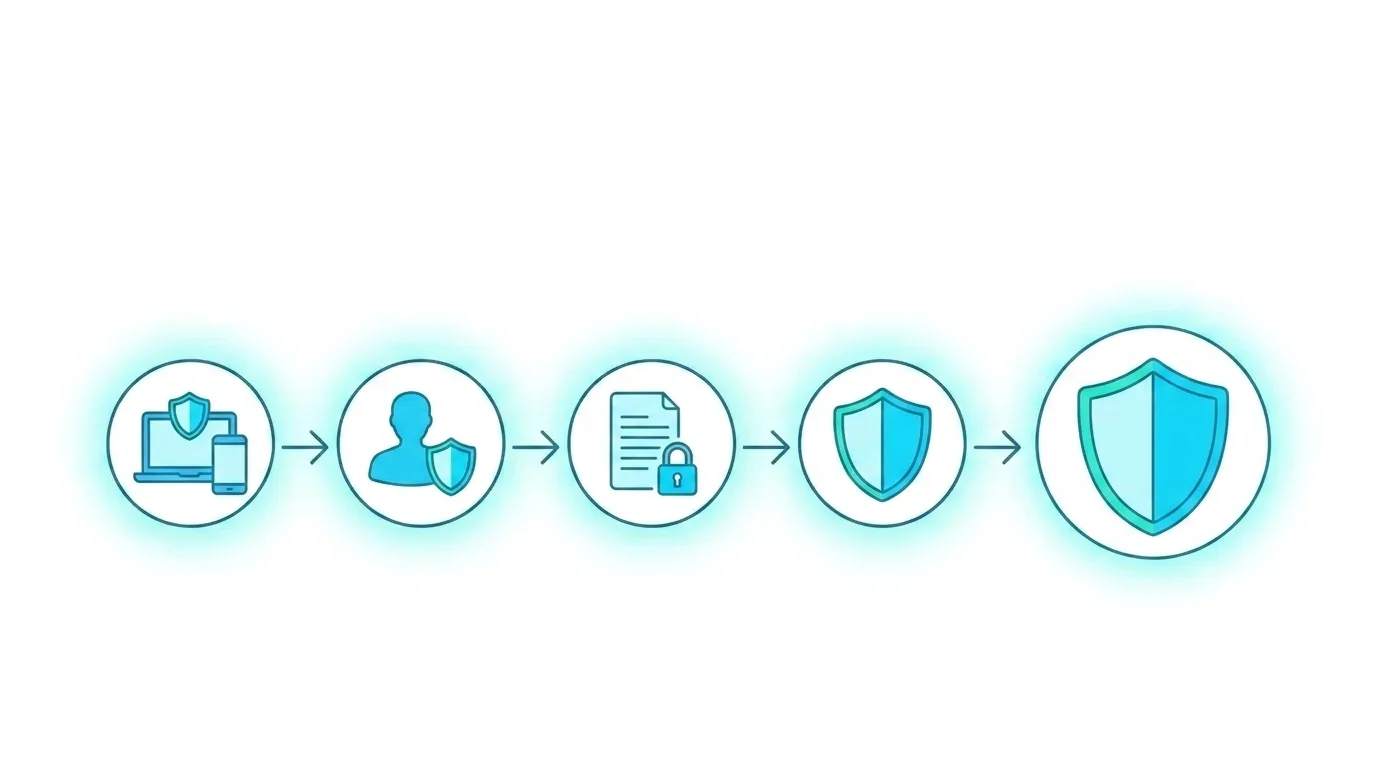
Modern endpoint management with Microsoft Intune. Enrollment policies for corporate and BYOD devices, an Autopilot process for Windows devices, Company Portal for application distribution, security baselines differentiated by operating system, automatic remediation actions and performance monitoring through Endpoint Analytics.
Advanced identity protection with Microsoft Entra ID. Conditional Access with restrictions by geographic location and by device state (managed or unmanaged), multi-factor authentication, self-service password reset and advanced password protection. On top of this sits Entra ID P2, with Privileged Identity Management for privileged roles, periodic Access Reviews and Identity Protection, which calculates sign-in risk and user risk and enables risk-based Conditional Access policies.
Data security with Microsoft Purview. Scanning of the environment to identify sensitive data, building the classification taxonomies, sensitivity labels with associated protections and inheritance rules, DLP policies to prevent data loss and retention policies differentiated by information type.
Endpoint protection with Microsoft Defender. Defender for Endpoint for agent deployment, Defender Vulnerability Management and Automated Investigation and Response; Defender for Identity with sensors on the Domain Controllers to detect anomalous behaviour, integrated with Microsoft Sentinel for event correlation and centralised alerting.
Where the signals meet
On this stack signals are exchanged at three points. The first concerns devices: Intune evaluates compliance, the policy can include the risk level calculated by Defender for Endpoint, and Conditional Access only allows access to corporate resources from compliant devices. The second concerns identities: Entra ID Protection calculates the risk and Conditional Access turns it into a request for multi-factor authentication or a secure password change, while Defender for Identity brings the signals coming from the Domain Controllers into Defender XDR and into Sentinel. The third concerns data: the sensitivity-label logs and the DLP alerts from Purview can flow into the same monitoring tools, so an event on data is read alongside one on identity and device.
The method: an incremental roll-out in four phases
The project was planned with an incremental approach, precisely to respect the constraint of never stopping operations.
Preparation and assessment covered the analysis of the existing infrastructure, the definition of security policies and the planning of the rollout.
The core implementation put in place the Intune setup and device enrollment, the configuration of Conditional Access and MFA, and the activation of the basic features of Defender for Endpoint and Defender for Identity.
The advanced configuration introduced Privileged Identity Management, Identity Protection with risk-based Conditional Access policies, DLP and data classification policies, Access Reviews and the fine tuning of the policies defined in the earlier phases.
Optimisation and handover closed with testing and validation, documentation, administrator training and operational handover. To stay focused on the goal (a solid, working security foundation) the project deliberately excluded related but non-central activities, such as data migration and application development.
The results
The group now has a unified security posture: identity, endpoints and data are no longer three separate problems, but a single system in which signals are correlated. User access is governed by risk-based rules, devices (corporate and personal) are managed against consistent baselines, sensitive data is classified and protected by automatic policies.
The concrete value lies in the integration between capabilities that, depending on the license tier, are often already included in the company’s Microsoft 365 subscription but are not activated or are not working together. Microsoft Sentinel is the exception, an Azure service billed on consumption. The security and compliance processes that previously required manual intervention are now largely automated, and the whole roll-out took place without interrupting the operations of the plants.
The expertise applied
This project is the operational demonstration of two areas in which Dev4Side has earned Microsoft Advanced Specializations: Identity & Access Management and Threat Protection. These are not abstract credentials: they are exactly the skills put to work to build Conditional Access, Privileged Identity Management and Defender for Identity in this project.
Who this approach is for
The approach is relevant for any organisation spread across multiple sites, with a heterogeneous device fleet and compliance requirements (manufacturing groups, industrial companies, cross-industry organisations). The usual starting point is not a lack of tools, but a lack of integration between tools that already exist. For groups with OT systems on the plant floor, the model needs to be extended with a dedicated track (network segmentation, for example with Microsoft Defender for IoT), because industrial systems have update and uptime constraints that differ from office IT. You can see other similar projects among our case studies.
If in your company identity, endpoints and data protection are still managed as three separate problems, we can help you unify them into a single plan. Contact us for an assessment

Written by
Emanuele Rossi
Infra & Security · Dev4Side