
LLM Wiki: the AI knowledge system behind our marketing team
How we built an AI-maintained knowledge base on the LLM Wiki pattern for our own marketing team: a single source that powers multiple sites and campaigns.
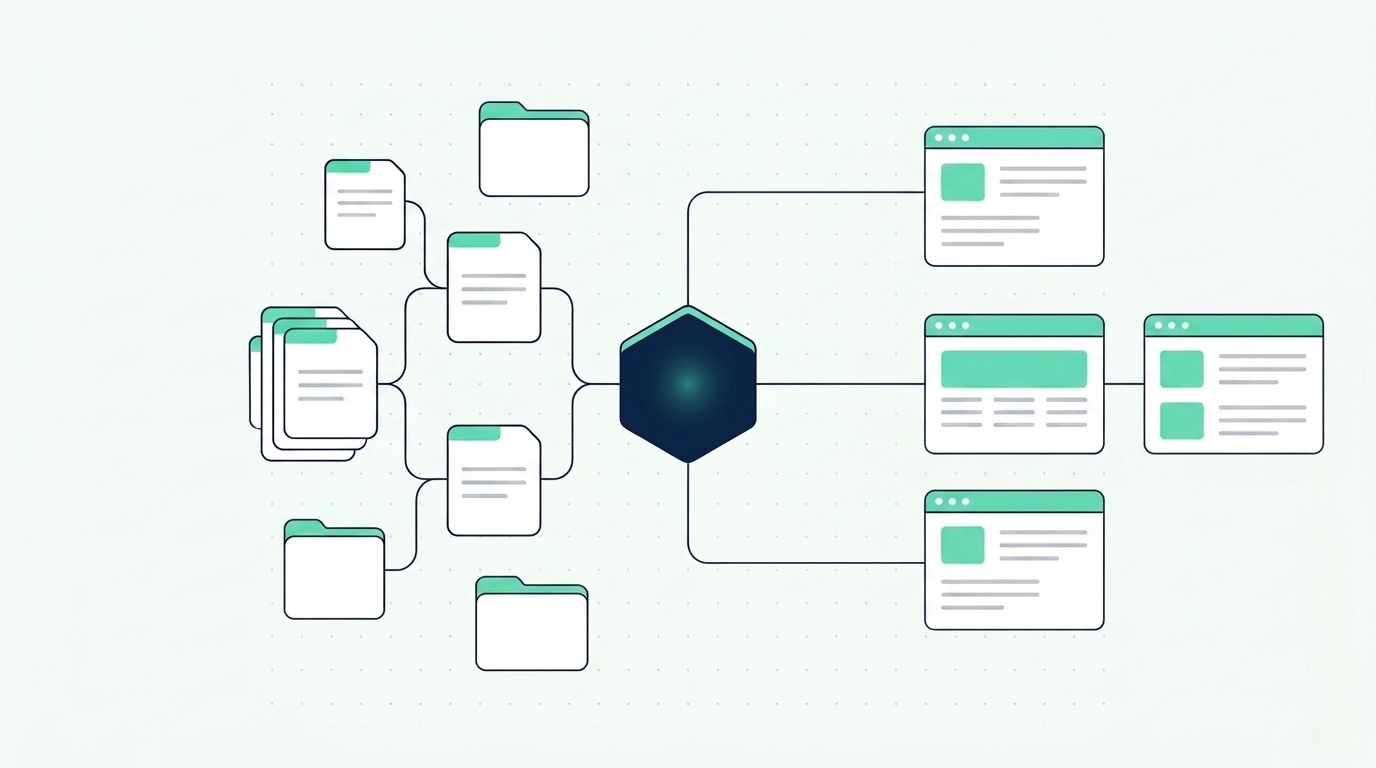
We wanted to test an idea we believe in — on ourselves: that a team’s knowledge can stop scattering across folders, documents and different tools, and instead become a single living base, maintained by artificial intelligence. So we built a knowledge management system based on the LLM Wiki pattern for our own marketing team. Here’s how it went.
The problem: knowledge scattered across too many projects
A marketing team managing several digital products quickly accumulates an enormous amount of knowledge: briefs, SEO audits, campaign data, decisions, content, technical details of every site. The problem isn’t producing this knowledge — it’s finding it again.
As the months go by, information ends up spread across shared folders, documents, spreadsheets and different tools. Knowing “what we decided for that campaign”, “what the SEO status of that site is” or “how to publish that project” becomes an exercise in archaeology. It’s the same frustration faced by almost every company that manages a lot of documentation: the knowledge is there, but it’s not accessible when you need it.
The solution: an AI-maintained knowledge base
We applied the LLM Wiki pattern, popularized by Andrej Karpathy: a knowledge base made of simple markdown files that an AI agent builds and keeps up to date, organized across three layers.
- Raw sources — briefs, SEO audits, transcripts, data — placed in an immutable area, the source of truth that’s never touched.
- The wiki — the pages generated by the agent: one page per project, plus campaigns, concepts, competitors and entities, all linked together by automatic cross-references.
- The schema — the instruction file that tells the agent how to structure and maintain the knowledge.
Every time a new source comes in, the agent reads it and updates the related pages across the system, flagging contradictions and stale information. Knowledge compounds like interest: every addition makes the whole richer, instead of staying isolated.
Integration with deployable sites
The real step change was connecting the knowledge base to the operational management of the projects. The same base that documents the portfolio sites also contains their code and publishing tooling: the sites are deployable directly from the same environment where the knowledge lives.
This means the line between “knowing” and “doing” gets thinner: a site’s documentation, its SEO strategy and its deployment don’t live in three separate worlds, but in a single coherent base. Everything stays in an open format — markdown files versioned in Git — with no lock-in to any platform.
The MCP servers: AI that talks to data and documentation
The engine that makes all this possible is the set of MCP servers (Model Context Protocol): the standard connectors that let the AI agent talk to external tools and to the team’s documentation. Instead of an isolated assistant, the agent becomes a node connected to multiple sources:
- the knowledge base itself — the project wiki — which acts as memory and context;
- the analytics and SEO tools (Google Analytics 4, Google Search Console, platforms like Ahrefs), from which it reads real performance data;
- the sites’ code, which it can act on directly.
The key point is that these servers talk to each other through the documentation: the agent cross-references a performance figure with what the team has written about that project and produces an immediate solution, already grounded in context. Not a generic suggestion, but a concrete action on the right site — driven by data and consistent with the documented strategy.
From data to action: analyzing performance and fixing it right away
Thanks to this network of connectors, the team can examine site performance directly — traffic and behavior metrics from Google Analytics 4, and queries, impressions, CTR and index coverage from Google Search Console — and move straight to the fix, in the same environment.
The loop closes in a single flow:
- You spot a signal in the data: a page losing rankings, a title with low CTR, a growing query not yet covered, a drop in impressions.
- You ask the agent to act: it reads the data, cross-references it with the site’s documentation and proposes (or applies) the fix — rewriting a title, creating a page for the emerging query, fixing hreflang, improving weak content.
- You publish the fix, first to staging then to production.
What normally takes several people and several tools — an analyst reading GA4, an SEO specialist deciding, a developer implementing — here happens in a single flow, with drastically reduced turnaround. It’s the difference between having a report and having already fixed it.
Editing, testing and publishing sites — with no technical overhead
The real step change isn’t just about documentation: the same knowledge base lets the marketing team operate the sites entirely on its own, without depending on a developer for every change. The flow is simple and covers the whole cycle, from edit to go-live.
- Edit content and code. A natural-language request to the AI agent — “update the SEO title of this page”, “write a new article on topic X in Italian and English”, “fix the hreflang on this site”, “add a FAQ section to this page” — turns into real changes to the site’s code. Marketing works on content, SEO and structure without writing code and without filing a ticket to development.
- Launch to staging. With a single command the site is built and published to a preview environment: you see the exact result — layout, links, schema, social preview — before touching production. You check, iterate, fix.
- Go to production. Once the change is approved, the same flow publishes the site to production in a controlled way, with deployments handled by centralized scripts and the option to roll back instantly if something goes wrong.
The result is the near-total removal of technical management as a bottleneck: the dead time between “marketing decides” and “development implements and ships” disappears. Whoever knows the content and the SEO can take it live themselves, safely — while still keeping a staging verification step and version control on every single change. For a team running multiple sites in multiple languages, this means speed (an SEO fix is applied and published the same day, not in weeks) and scalability (the same small team covers many more projects).
The results
The system is now the single source of truth for the marketing team across multiple digital products — and, at the same time, its operational cockpit. Concretely:
- knowledge no longer gets lost between different tools: projects, campaigns, SEO audits and decisions live in a single queryable base;
- changes to the sites — content, SEO, new pages, translations — are made in natural language, without going through development;
- performance is read directly from GA4 and Google Search Console (via MCP servers) and fixes are applied immediately, in the same environment: from the data to the published correction;
- every change gets a staging preview and ships to production through a controlled, versioned flow;
- the dependency on the technical team for routine editorial and SEO work is reduced to almost zero, freeing developers for higher-value work;
- the entire body of knowledge stays in an open format, owned by the company, with no lock-in.
Above all, this project is concrete proof of an approach we can bring to any company: turning a team’s distributed knowledge into a living asset, maintained by AI and integrated with everyday work tools — to the point of making it operational, able not just to answer but to act. It’s exactly the kind of system we design for our clients in the Microsoft 365 and Azure ecosystem.
Want to understand how an AI knowledge base could work in your organization? Talk to one of our experts.

Written by
Miro Radenovic
Modern AI Apps · Dev4Side