
AI-Powered Corporate Knowledge Base: What It Is and How to Build It
What an AI-powered corporate knowledge base is, the benefits it delivers and how to build one with Microsoft 365 and Azure. A practical guide for businesses.
What an AI-powered corporate knowledge base is
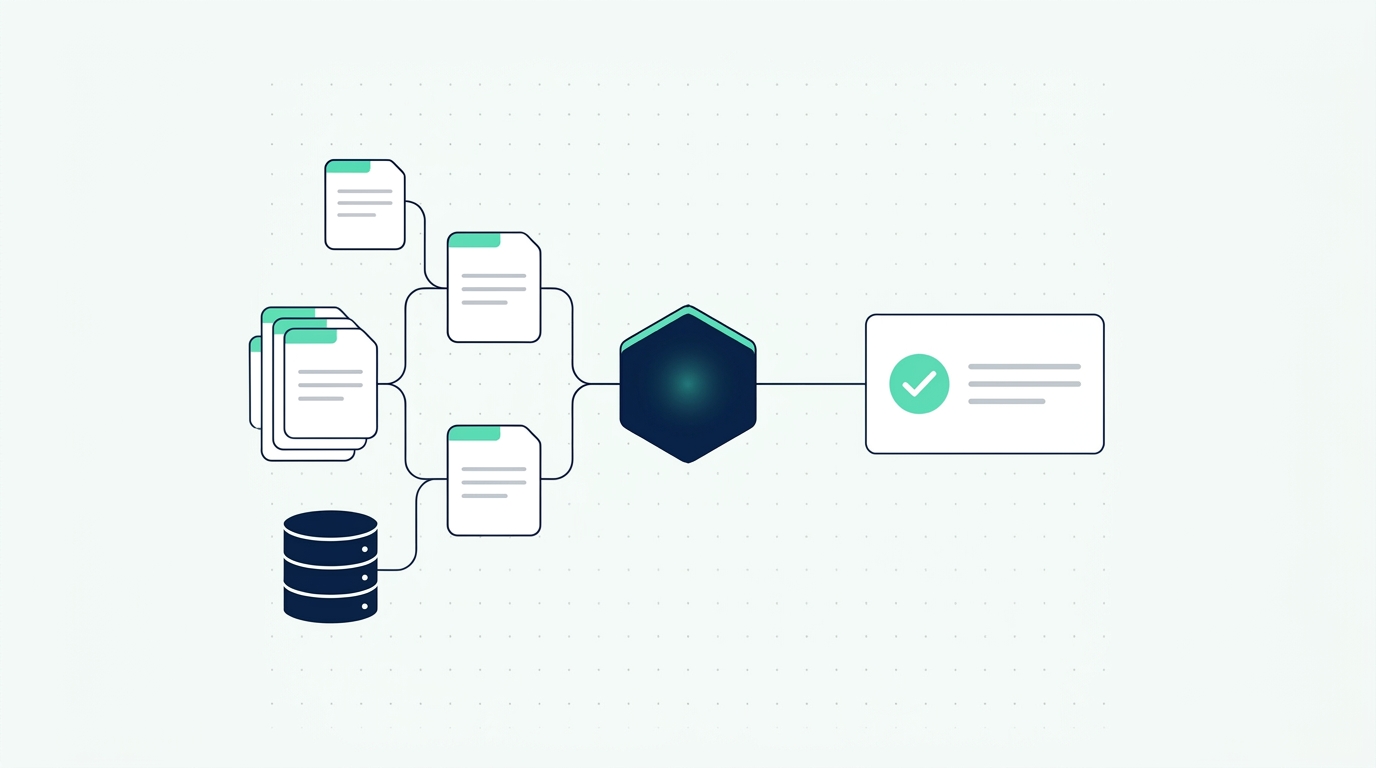
A corporate knowledge base is the organised body of a company’s internal knowledge, including procedures, technical documentation, decisions, contracts and FAQs, made accessible and searchable. When it is powered by artificial intelligence, it stops being a static archive where you have to know where to look and becomes a system you can query in natural language: you ask a question and get a concise answer, grounded in your documents and with the sources cited.
It is the difference between having information and being able to use it. And for many companies it is the difference between a productive working day and one spent hunting for the right file.
The problem it solves
The cost of scattered knowledge is concrete and measurable. According to McKinsey research, knowledge workers spend roughly 20% of the working week, almost a full day, searching for internal information and tracking down the colleagues who hold it (McKinsey, The social economy).
On top of this daily cost comes a more insidious one: the loss of institutional knowledge. When an experienced person leaves the company, they take with them context that was often never written down anywhere. A living knowledge base, fuelled by AI, turns that implicit knowledge into a corporate asset that stays.
The benefits of an AI-powered knowledge base
- Immediate answers, not just search. The user asks in natural language and receives a synthesis, not ten links to open one by one.
- Synthesis across different sources. AI pulls together information scattered across documents, intranets and threads, returning a coherent picture.
- Fewer hallucinations. By grounding answers in corporate documents and citing the sources, the system is verifiable and reliable.
- Faster onboarding. New hires find answers on their own, without having to interrupt more experienced colleagues.
- Knowledge that compounds. With the right patterns, every new document enriches the system instead of staying isolated.
Concrete use cases, department by department
An AI knowledge base is not an abstract project: it delivers different value depending on who uses it. Here are the scenarios we see most often in companies.
- Customer support and help desk. Agents query manuals, procedures and historical tickets in natural language and find the right answer in seconds, cutting handling times and standardising answer quality.
- HR and onboarding. New hires ask about leave, policies and internal processes and get instant answers, without interrupting colleagues. Company knowledge becomes accessible from day one.
- Legal and compliance. Clause extraction, contract comparison and compliance checks across a document library: tasks that used to take hours become natural-language questions.
- Sales. Quick answers on products, pricing and references, plus assisted completion of tenders and RFPs by retrieving content written in the past.
- R&D and engineering. Immediate access to technical documentation, architectural decisions and lessons learned, so project knowledge no longer lives in the heads of a few people.
Many sectors benefit from it: we have collected more examples and use cases of RAG technology, which is often the engine behind these knowledge bases.
The two architectures: RAG and LLM Wiki
There is no single way to build an AI knowledge base. The two reference architectures are complementary.
RAG (Retrieval-Augmented Generation) retrieves the relevant passages from documents at every question and feeds them to the model as context. It is ideal for large volumes and for data that changes frequently.
The LLM Wiki has an AI agent synthesise the knowledge only once, at ingestion time, producing pages that are already linked to one another. It is ideal when consistency and accumulation matter, on a base of manageable size.
Which one should you choose? It depends on data volume, update frequency and consistency requirements, and the answer is often a hybrid approach. We have dedicated an article to the comparison: LLM Wiki vs RAG.
How to build it with Microsoft 365 and Azure
For companies already in the Microsoft ecosystem, the AI knowledge base plugs into the tools employees use every day. A typical architecture connects:
| Component | Role |
|---|---|
| SharePoint / Teams / OneDrive | Document sources, with permissions already configured |
| Azure OpenAI | Generative model inside the corporate perimeter |
| Azure AI Search | Retrieval layer for RAG over large volumes |
| Maintenance agent | Updates the knowledge incrementally (LLM Wiki pattern) |
The decisive advantage of building on Azure OpenAI is data security: unlike public tools such as ChatGPT, requests are processed within the customer’s Microsoft cloud and sensitive information never leaves the corporate infrastructure. A non-negotiable requirement for regulated industries.
The phases of an AI knowledge base project
A project that works does not start from the model, but from a gradual path that reduces risk and proves value before scaling.
- Discovery. You identify the highest-value use case and map the document sources, existing permissions and compliance requirements. This is the phase where you decide what the knowledge base needs to know and who can see what.
- Proof of concept. On a narrow domain you build a working prototype to validate answer quality against the company’s real data. A few weeks, with a clear goal.
- Pilot. You open the system to a small group of real users, gather feedback and refine retrieval, synthesis and the interface.
- Rollout and governance. You extend to other departments and sources, defining the continuous-update process, quality monitoring and audits. This is where the knowledge base becomes a stable asset rather than an experiment.
The guiding principle is one: start narrow, prove the return, then expand. The projects that fail are almost always the ones that try to do everything at once.
The mistakes to avoid
Many AI knowledge base projects fail not because of the model, but because of what surrounds it:
- Messy data going in. Answer quality depends on the quality and structure of the documents. Cleaning up and organising the sources comes before the model.
- Ignored permissions. A knowledge base that shows confidential documents to everyone is a security problem, not a feature. Permissions must be enforced at the retrieval layer.
- No update plan. A base that does not update ages quickly and loses trust. You need a process, manual or automated, of continuous ingestion.
- Starting too big. The path that works is to start from a high-value, well-defined use case, prove its return, then expand.
How to measure the return on investment
An AI knowledge base should be evaluated like any investment: with clear metrics. The most meaningful are:
- Information search time. This is the most direct metric: how much you reduce the time people spend finding what they need. Considering that, according to McKinsey, this amounts to about one working day per week, even a partial improvement has a significant economic impact.
- Resolution time (for support). How much you shorten the handling of a request or a ticket.
- Onboarding time. How much sooner a new hire becomes operational and self-sufficient.
- Self-service rate. How many questions are answered without having to involve a person.
- Answer quality and consistency. Measurable through user feedback and spot checks.
The practical advice is to define a baseline before you start, how much time is lost today and how many tickets are opened, so you can demonstrate the return with concrete numbers after the pilot. It is also the best way to build the business case for leadership.
How to get started
An AI-powered corporate knowledge base is not an off-the-shelf product: it is a system to be designed around your data, your permissions and your use cases. The technology is mature; the value lies in the engineering that integrates it securely into your environment.
At Dev4Side we build corporate knowledge bases on Microsoft 365 and Azure, from proof of concept to production system, applying the same approach to ourselves too, as shown by our LLM Wiki for marketing. If you want to explore a concrete path, talk to one of our experts or take a look at a RAG project we have delivered.
Frequently asked questions
What is a corporate knowledge base? It is the organised body of a company’s internal knowledge, including procedures, documentation, decisions and FAQs, made accessible and searchable. With AI it stops being a static archive and becomes a system you can query in natural language, answering with citations from your corporate documents.
What is the difference between a traditional knowledge base and an AI-based one? A traditional knowledge base (wiki, intranet, shared folders) requires you to know where to look and is updated manually. An AI knowledge base answers questions in natural language, synthesises information from multiple sources and, with patterns such as the LLM Wiki, can update itself incrementally.
What technologies do you need to build one? It depends on the use case. The two main architectures are RAG (retrieving documents at every query) and the LLM Wiki (knowledge synthesised at ingestion time). In a Microsoft environment, SharePoint and Teams serve as sources, Azure OpenAI as the model and Azure AI Search as the retrieval layer.
Does corporate data stay secure? Yes, if the architecture is designed well. With Azure OpenAI, requests are processed inside the customer’s Microsoft cloud, so data never leaves the corporate perimeter, while existing permissions and compliance requirements are respected.
How long does it take to build? A proof of concept on a narrow domain can take a few weeks; an integrated, governed system across multiple sources takes longer. The recommended approach is to start from a high-value, well-defined use case, then expand.
Frequently asked questions
What is a corporate knowledge base?
What is the difference between a traditional knowledge base and an AI-based one?
What technologies do you need to build one?
Does corporate data stay secure?
How long does it take to build?

Written by
Davide Mazzoli
Modern AI Apps · Dev4Side
Dev4Side Software · Microsoft Gold Partner
Need help implementing this in your company?
Our specialist teams have delivered 200+ Microsoft implementations across Italy. Contact us for a free, no-obligation evaluation of your project.
Related articles
LLM Wiki: what it is and how the self-updating knowledge base works
The LLM Wiki is the knowledge base an AI agent builds and updates on its own from your documents. What it is, how it works and how to bring it in-house.
LLM Wiki vs RAG: differences and when to choose each
LLM Wiki and RAG compared: how they work, costs, accuracy and when to choose one, the other or a hybrid approach. A practical guide for businesses.
Azure OpenAI RAG: the enterprise approach to generative AI
Azure OpenAI RAG combines GPT with enterprise data for accurate AI responses. Architecture patterns, implementation steps, and business benefits explained.