
Knowledge management with AI: how to manage company knowledge
How artificial intelligence is reshaping enterprise knowledge management: from the limits of traditional systems to AI architectures like RAG and LLM Wiki.
What knowledge management is
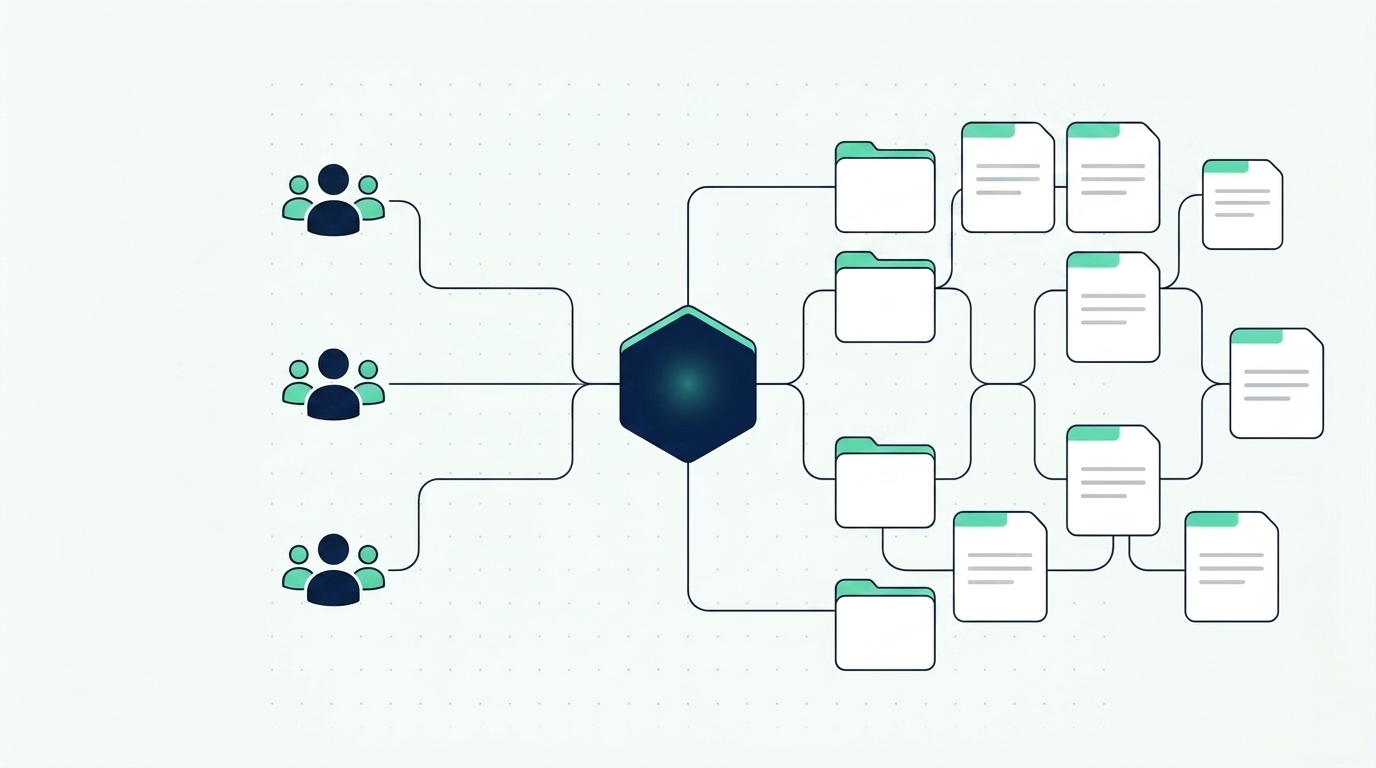
Knowledge management is the set of practices, processes and tools an organization uses to create, organize, share and preserve its knowledge. The goal is easy to state and hard to achieve: getting the right information to the right person at the right time, preventing company expertise from being scattered, duplicated or lost when someone leaves.
For decades, knowledge management was mainly an organizational problem. With artificial intelligence it has become, for the first time, a problem that can also be solved technologically, and far more effectively.
The three pillars of knowledge management
Knowledge management is not just technology: it rests on three pillars that have to work together.
- People. Knowledge is born and lives in people. Without a culture of sharing, and without incentives to document rather than hoard, no tool works.
- Processes. You need rules for how knowledge is created, validated, updated and retired when it becomes obsolete. It is the processes that keep the knowledge base from turning into a graveyard of outdated documents.
- Technology. The tools that make knowledge accessible and searchable. This is the pillar AI affects most, but on its own it is not enough: excellent technology on top of non-existent processes still produces chaos.
The value of a well-executed project lies precisely in aligning the three pillars, not in buying yet another piece of software. AI is a powerful multiplier, but it multiplies whatever it finds.
Explicit knowledge and tacit knowledge
A classic distinction helps clarify where AI can really make a difference. Explicit knowledge is what has already been written down: manuals, procedures, documentation. It is easy to store but often hard to retrieve when you need it. Tacit knowledge is what people carry in their heads, the “how it’s really done”, the context behind decisions, the shortcuts learned on the job, and it rarely ends up in a document.
Traditional knowledge management handles the former reasonably well and the latter almost not at all: tacit knowledge is precisely what gets lost when an experienced person leaves the company. This is where AI opens up a new possibility: capturing fragments of tacit knowledge as they surface, from a call, a thread, a decision documented on the fly, and turning them into reusable explicit knowledge. It is exactly what a pattern like the LLM Wiki does with every ingestion.
The historical limit (and why AI overcomes it)
Anyone who has worked in a company knows the arc of traditional knowledge management: a rich, well-crafted wiki or intranet gets created, and within a few months no one updates it anymore. Not out of bad faith, but because maintaining knowledge is continuous work that collides with everyday priorities.
The result is a double frustration: systems full of information that can’t be found when needed, and the hidden cost of searching. According to McKinsey, knowledge workers spend roughly 20% of the week, almost a full day, looking for internal information and tracking down the colleagues who hold it (McKinsey, The social economy).
AI changes the equation on two fronts: it makes knowledge queryable in natural language, so you no longer need to know where to look, and, with the more advanced patterns, it reduces the manual work of maintenance, the exact point where traditional systems get stuck.
Knowledge management and knowledge base: what’s the difference
The two terms are often confused. Knowledge management is the overall discipline: processes, culture, tools. The knowledge base is one of the tools that puts it into practice, the organized repository of knowledge. AI enhances both: it improves the tools (smarter knowledge bases) and enables processes that were previously impossible (automatic maintenance, synthesis across sources).
AI architectures for knowledge management
On the technical side, two patterns make the difference.
RAG (Retrieval-Augmented Generation) connects an AI model to company documents, retrieving the relevant passages for each question. It is the right choice for large volumes and data that changes often. We have collected concrete examples and use cases.
The LLM Wiki, popularized by Andrej Karpathy, has an AI agent synthesize knowledge at ingestion time: every new source updates the related pages, and knowledge compounds like interest. It is particularly well suited to knowledge management because it tackles the maintenance problem head-on: it is the AI that keeps the wiki up to date, not the people.
The choice between the two, or their combination, depends on context. The full comparison is in the article LLM Wiki vs RAG.
Knowledge management in the Microsoft ecosystem
For companies on Microsoft 365, knowledge management doesn’t require rebuilding everything from scratch: it grafts onto existing tools. SharePoint and Teams are already the containers of knowledge; Azure OpenAI adds the generative layer within the corporate security perimeter; Azure AI Search provides retrieval over large volumes.
Tools like Microsoft 365 Copilot also fit into this picture, bringing AI assistance inside everyday applications. The added value of a tailored project lies in connecting these pieces into a coherent, governed system aligned with the company’s real processes.
The concrete benefits for the business
AI-powered knowledge management is not a theoretical exercise: it produces measurable everyday gains.
- Less time wasted searching. This is the most direct benefit: people find answers instead of hunting for them or interrupting colleagues.
- Faster onboarding. New hires become self-sufficient sooner, because company knowledge is queryable from day one.
- Better decisions. When historical context and relevant data are just a question away, decisions are made on firmer ground.
- Continuity. Critical knowledge no longer depends on the presence of specific people: it stays in the organization even when someone changes roles or companies.
- Knowledge that compounds. With the right patterns, every new contribution enriches the system instead of dispersing, turning company expertise into an asset that grows over time.
The common thread is always the same: moving knowledge out of people’s heads and scattered documents into a living, shared, queryable system.
The mistakes to avoid
Even with AI, knowledge management projects can fail, and almost always for reasons that have nothing to do with technology.
- Relying on the tool alone. Buying a platform and expecting it to solve everything, while ignoring people and processes, is the classic recipe for failure.
- Loading messy data. The quality of the answers depends on the quality of the sources: duplicate, outdated or contradictory documents produce unreliable answers. Data cleanup comes before the model.
- Assigning no ownership. If no one is responsible for keeping knowledge alive, the system ages and loses trust. You need an owner, even when updates are partly automated.
- Starting too big. Trying to cover the whole company from day one spreads your energy thin. Better one well-executed use case than ten half-baked ones.
- Neglecting permissions and compliance. In a system that spans all company knowledge, governance and security are not a final add-on: they are part of the project from the very start.
Avoiding these mistakes matters more than any technology choice: it is what separates a project that generates value from one that ends up abandoned.
Where to start
Knowledge management with AI isn’t bought: it’s designed. And the approach that works doesn’t start from technology, but from a business question: what is the knowledge that, if it were immediately available, would make the biggest difference? You start there, with a high-value, well-scoped use case, you measure the result, then you extend.
At Dev4Side we design AI-based knowledge management systems, integrated with Microsoft 365 and Azure and built around your processes. We did it for our own team too: discover our LLM Wiki for marketing. If you want to turn your company’s knowledge into an asset that grows over time, talk to one of our experts.
Frequently asked questions
What is knowledge management? Knowledge management is the set of practices and tools an organization uses to create, organize, share and preserve its knowledge. The goal is to get the right information to the right person at the right time, avoiding fragmentation and duplication.
How does AI change knowledge management? AI solves the historical limit of knowledge management: traditional systems require people to update and search manually. With AI, knowledge can be queried in natural language and, with patterns like the LLM Wiki, kept up to date incrementally by the agent itself.
What is the difference between knowledge management and a knowledge base? Knowledge management is the overall discipline (processes, culture, tools); the knowledge base is one of the tools that puts it into practice, namely the organized repository of knowledge. AI enhances both.
Why do traditional knowledge management projects fail? Often because they depend on people’s discipline: wikis and intranets that are rich at the start get abandoned because no one has time to keep them updated. AI tackles exactly this, reducing the manual work of maintenance and synthesis.
Where is it best to start? From a high-value, well-scoped use case, for example the knowledge base of a single department, measuring the results before extending it. In a Microsoft setting, integration with SharePoint, Teams and Azure lets you start from the tools already in use.
Frequently asked questions
What is knowledge management?
How does AI change knowledge management?
What is the difference between knowledge management and a knowledge base?
Why do traditional knowledge management projects fail?
Where is it best to start?

Written by
Miro Radenovic
Modern AI Apps · Dev4Side
Dev4Side Software · Microsoft Gold Partner
Need help implementing this in your company?
Our specialist teams have delivered 200+ Microsoft implementations across Italy. Contact us for a free, no-obligation evaluation of your project.
Related articles
AI-Powered Corporate Knowledge Base: What It Is and How to Build It
What an AI-powered corporate knowledge base is, the benefits it delivers and how to build one with Microsoft 365 and Azure. A practical guide for businesses.
LLM Wiki: what it is and how the self-updating knowledge base works
The LLM Wiki is the knowledge base an AI agent builds and updates on its own from your documents. What it is, how it works and how to bring it in-house.
LLM Wiki vs RAG: differences and when to choose each
LLM Wiki and RAG compared: how they work, costs, accuracy and when to choose one, the other or a hybrid approach. A practical guide for businesses.