
Sveva.ai: conversational business intelligence in natural language
How we built Sveva.ai, the AI agent that turns fragmented ERP and CRM data into business insights accessible in natural language from Microsoft Teams.
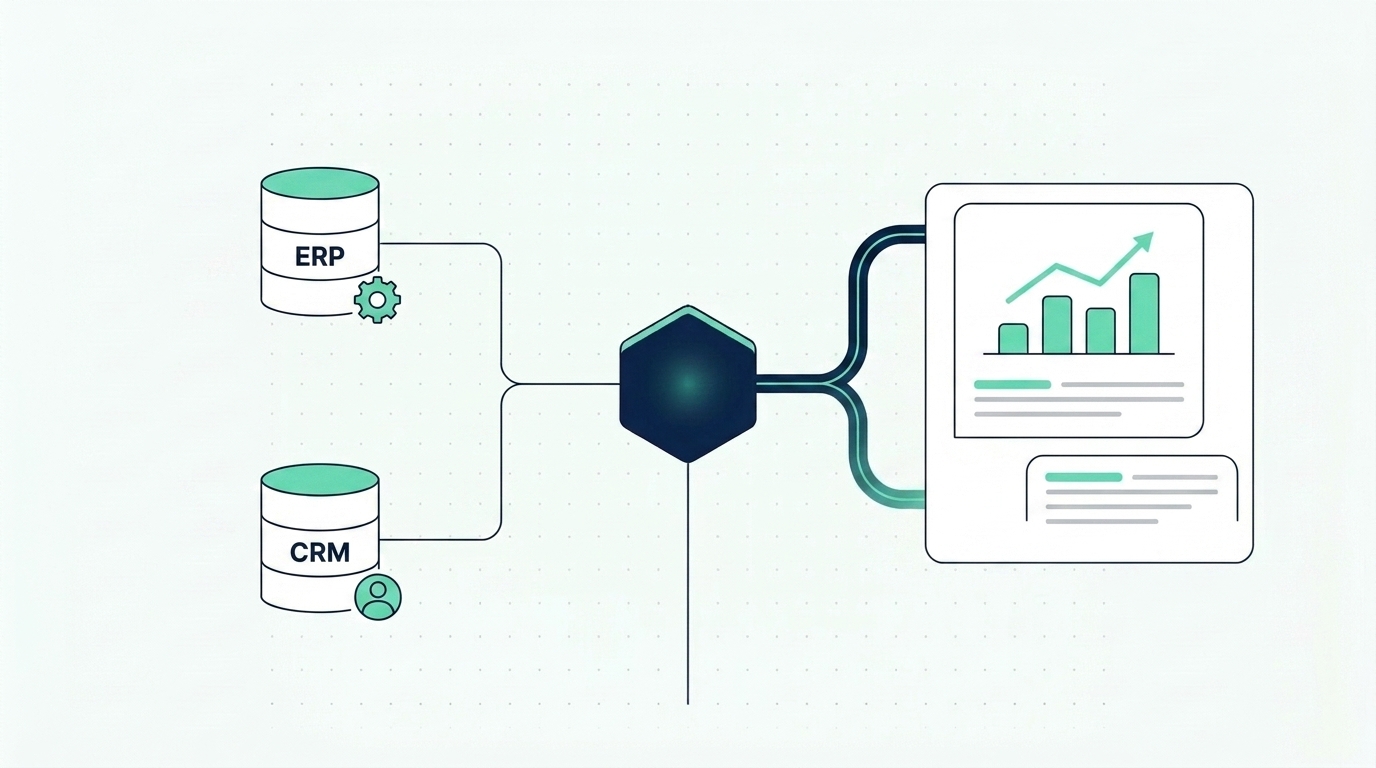
Companies don’t have a data problem: they have too much data, scattered everywhere. Sveva.ai was born from this observation — the AI agent we built to turn the fragmented data of ERP, CRM and management systems into business insights accessible to anyone, simply by asking a question. Here’s how.
The problem: data everywhere, visibility nowhere
In most companies the information that matters is spread across different systems: the ERP for operational figures, the CRM for sales, spreadsheets and tools for everything else. The result is a lack of unified visibility: to answer a seemingly simple question — “what’s the margin on this project this month?” — you have to manually combine data from different sources, risking slow decisions based on already-outdated information.
Traditional business intelligence tools help, but at a cost: they require dashboards and reports built in advance, by specialists, for every anticipated question. When a new question comes up, the cycle starts over.
The solution: an “AI colleague” that speaks the language of business
Sveva.ai flips the approach. Instead of building dashboards, the user asks the question in natural language — in English or Italian — and gets the answer directly in Microsoft Teams, the tool they already use every day.
Under the hood, the platform connects ERP, CRM and management systems into a single source of truth, and on that basis answers questions about margins, sales pipeline, EBITDA and other key indicators. It’s essentially an AI colleague you can ask for a figure the way you’d ask an analyst — without the wait.
Key capabilities include:
- Unified Intelligence — connects company systems, eliminating data silos;
- Natural-language queries — no dashboards to configure, just questions and answers;
- Multi-model architecture — picks the most suitable LLM for each request;
- Conversation history — searchable, exportable and auditable, a key requirement in regulated contexts;
- Custom connectors — integration with existing data warehouses and systems.
The “Rhythm of Business” methodology
The value of Sveva.ai lies not only in the technology, but in how it’s designed for real work. The proprietary “Rhythm of Business” framework structures the company’s recurring questions around its natural cadence: the weekly review, the monthly close, the quarterly forecast. This way the agent isn’t just reactive — it accompanies the organization’s key decision moments.
What we built, concretely
Sveva.ai isn’t a prototype: it’s a platform with real components, designed to hold up to daily use in a company. Among the concrete solutions we delivered:
- A natural-language query engine that turns a business question — “what’s the margin on project X this month?”, “how did the pipeline do versus last quarter?” — into queries against company data, returning figures and explanations, not just charts.
- A multi-model architecture (Claude, OpenAI, Mistral AI, DeepSeek): the agent picks the most suitable LLM for each request, balancing quality, cost and task type, without locking into a single provider.
- Custom connectors to ERP, CRM, data warehouses and management systems, unifying into a single source of truth data that previously lived in separate silos.
- Native Microsoft Teams integration: insights land inside the tool people already use every day — no new software to adopt and roll out.
- A library of pre-configured prompts for the business’s recurring use cases, so value arrives from day one without having to “learn how to query” the system.
- Searchable, exportable and auditable conversation history, a key requirement in regulated contexts where every answer must be traceable.
The common thread is one: turning a question asked in words into a reliable answer, grounded in the company’s real data, in seconds — and putting it in the hands of decision-makers, not just analysts.
From data to decision, in real time
As with an operational knowledge base, the value of Sveva.ai lies in closing the gap between data and action. The connectors to ERP, CRM and data warehouses are the fabric that lets the agent dialogue with company systems: it doesn’t read static data exported once, but queries the up-to-date sources at the moment they’re needed.
This enables two complementary modes:
- On demand — the user asks, Sveva queries the unified data and answers with the figure and its explanation: from question to insight in seconds, with no queue at the controlling office.
- Proactively — following the Rhythm of Business methodology, the agent accompanies the key moments (weekly review, monthly close, forecast) and surfaces the signals that matter — a falling margin, a pipeline below target — before they become a problem.
In both cases the result is the same: the decision-maker doesn’t get a report to interpret, but an answer to act on. It’s the difference between measuring and deciding.
Why it matters
Sveva.ai is a concrete example of what it means to bring an AI agent into business processes: not an experiment, but a tool that puts real insights in the hands of decision-makers, inside the work environment they already use. It’s the same kind of capability — AI agents that turn data and knowledge into operational value — that we apply to our clients’ projects, with particular attention to the difference between retrieving data and synthesizing it into knowledge.
Want an AI agent that makes your company’s data talk? Talk to one of our experts.

Written by
Davide Mazzoli
Modern AI Apps · Dev4Side